
Beyond the Tech Giants: Where Successful GTM Leaders Really Come From
An analysis of 10,000 senior go-to-market leaders from around the world and to find the patterns and insights to guide you when hiring these specialists.
Most companies assume their next CRO or CGO will come from a technology company. The data tells a different story.
We analysed 10,000 senior GTM leaders and 80,788 career history records from the MapX database. What we found challenges the conventional wisdom about where commercial leadership talent is actually developed — and raises important questions about how companies source senior hires.
The Headline Finding: Consumer Goods Companies Are Leadership Factories
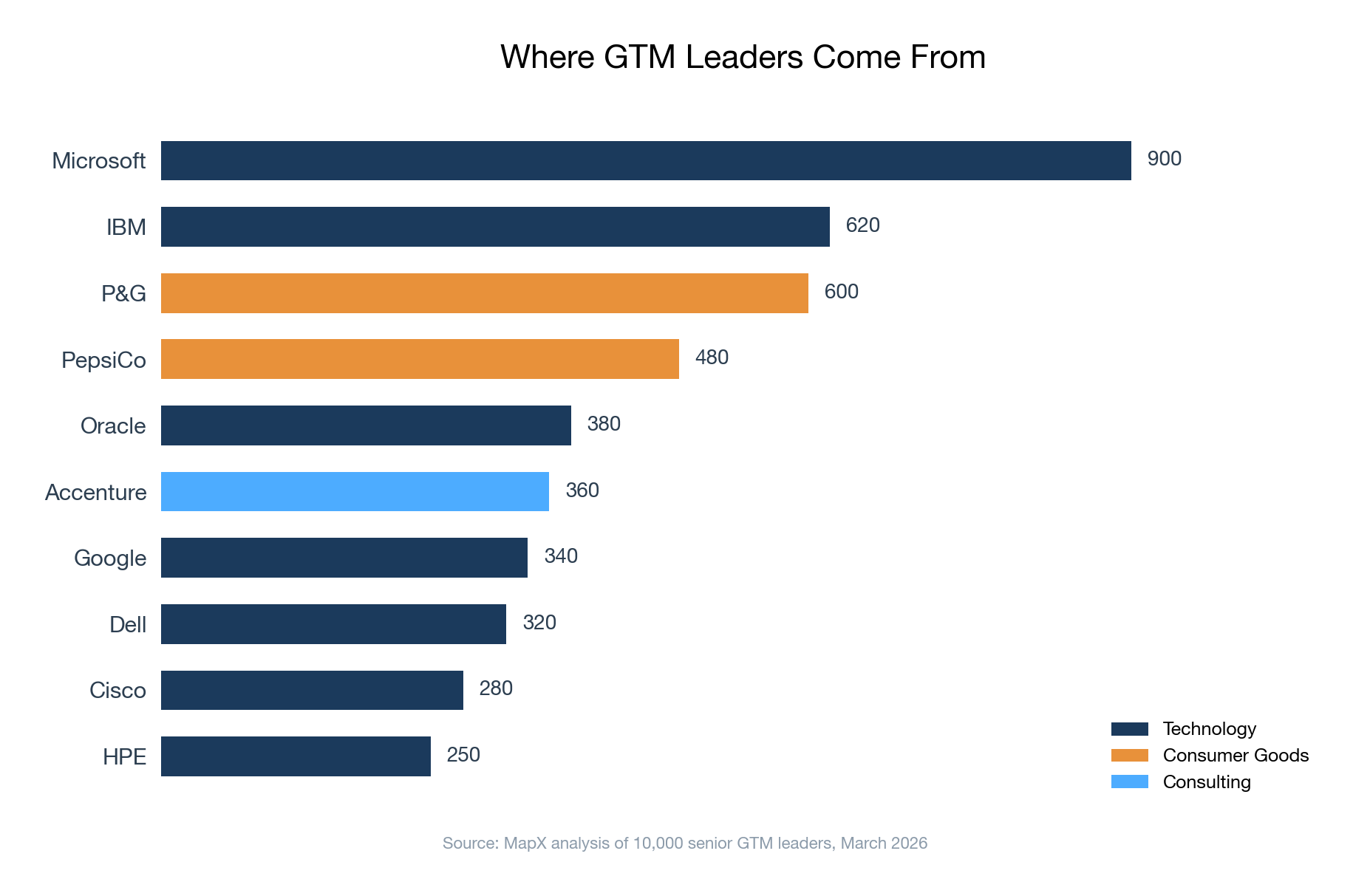
When we looked at where today's senior GTM leaders spent earlier stages of their careers, the results were surprising.
Where GTM Leaders Come From
Microsoft leads with 900 appearances across career histories. But the next tier isn't dominated by technology companies. Procter & Gamble (600), IBM (620), and PepsiCo (480) all feature prominently — ahead of Google (340) and Oracle (380).
The implication: consumer goods companies — with their emphasis on P&L ownership, multi-channel commercial strategy, and structured leadership development — are producing a significant share of the leaders who go on to run commercial functions elsewhere.
But this doesn't mean you can simply "hire from P&G."
The Reality Check
P&G candidates are not readily available. Compensation gaps can be significant — P&G senior leaders earning £150K–£250K may need 50–100% increases to move to high-growth technology companies. Hiring managers often default to "someone who's done it in tech," creating a perception barrier that's difficult to overcome. And the best performers at these companies have clear progression paths — they may not want to leave.
When to target consumer goods candidates: When the role emphasises enterprise sales, P&L ownership, or multi-channel experience — and when the hiring manager is genuinely open to non-traditional backgrounds.
When not to: Fast-paced early-stage companies where "SaaS-native" experience is critical, or where compensation budgets can't compete.
The CGO Pathway Doesn't Run Through Technology
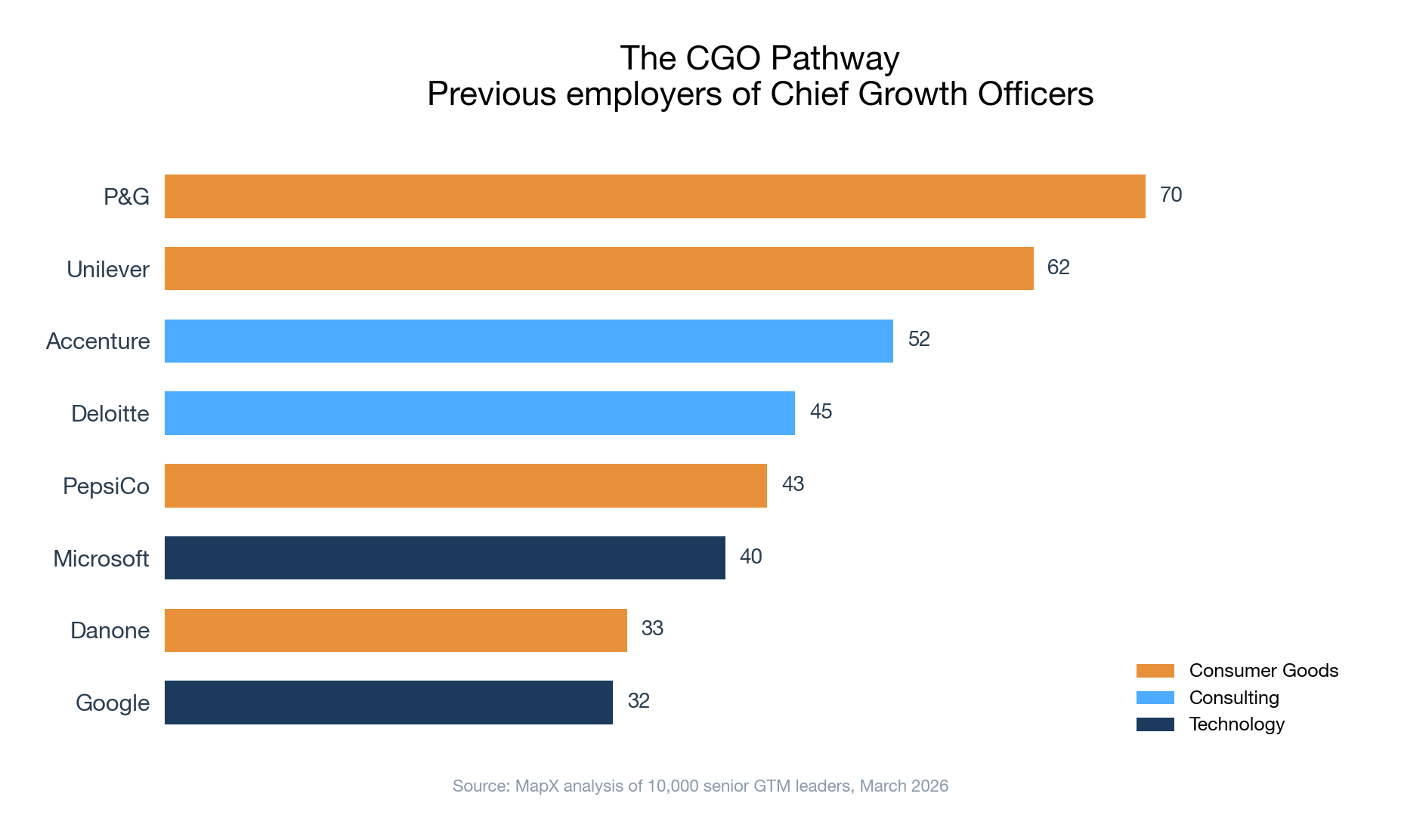
Of 1,350 Chief Growth Officers in our dataset, the most common previous employers were P&G (70), Unilever (62), Accenture (52), Deloitte (45), and PepsiCo (43). Microsoft appears sixth.
The CGO Pathway
Two distinct career patterns emerge: operating backgrounds (P&G, Unilever, PepsiCo, Danone) and consulting backgrounds (Accenture, Deloitte). Each brings different strengths and different risks.
Consulting backgrounds are typically easier to engage — these candidates are more open to change. But they carry a higher fall-off risk. The transition from advising to executing is genuine, and cultural mismatch is common.
Operating backgrounds are harder to engage but convert more reliably. The experience is directly relevant. The challenge is convincing hiring managers that category-specific experience (say, "Director of Sales, Fabric Care") translates to a different context.
The Market Is Structurally Closed
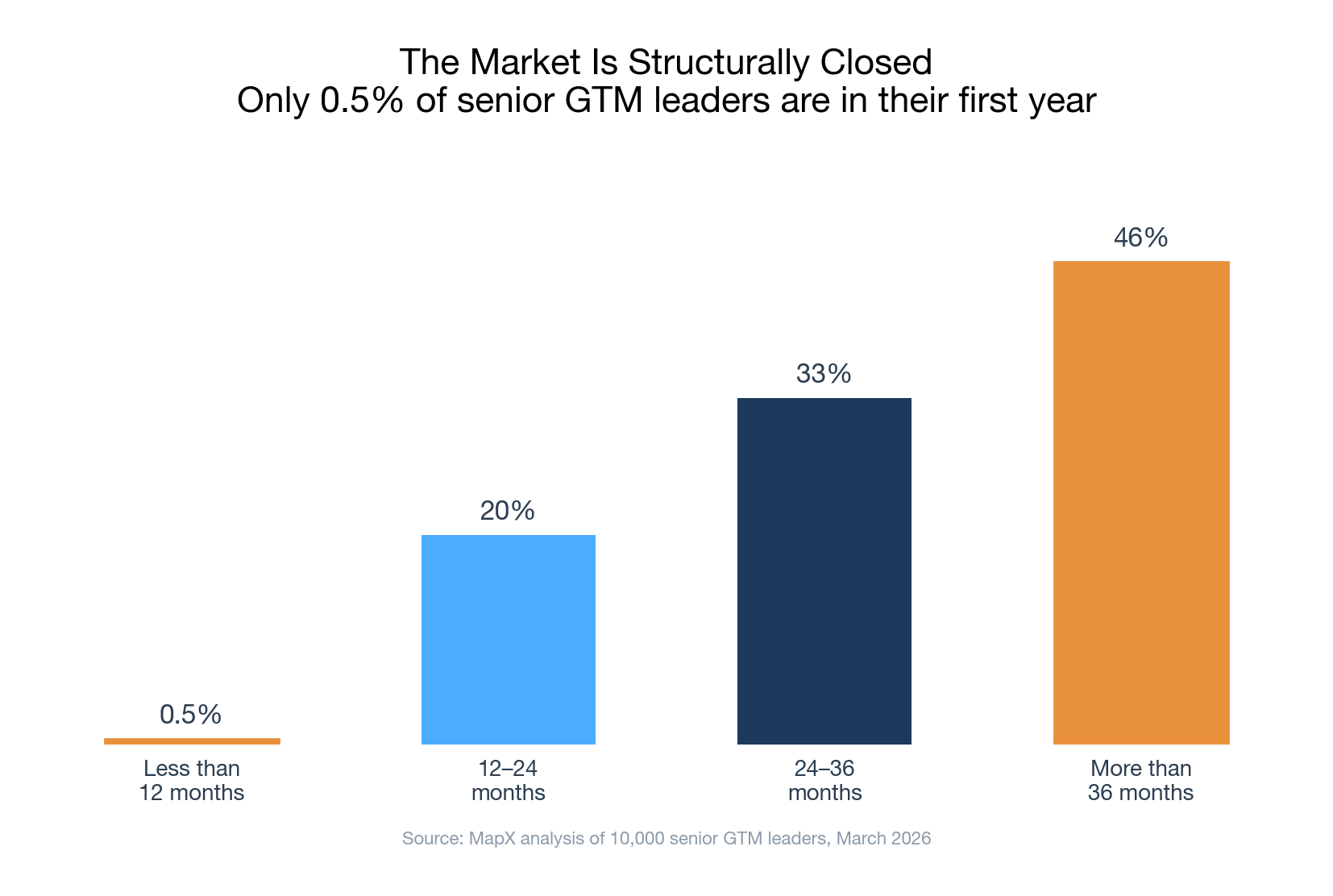
Perhaps the most practically useful finding: only 0.5% of senior GTM leaders are in their first year in role. 46% have been in position for more than three years.
The Market Is Structurally Closed
This isn't a temporary market condition. It's structural. The overwhelming majority of senior commercial leaders are not looking, not available on job boards, and not responding to recruiter outreach from companies they've never heard of.
The practical implications are straightforward:
- Active sourcing is mandatory. Posting jobs and waiting doesn't work at this level.
- Relationship-building takes time. The best time to source a CRO is 18 months before you need one.
- Employer brand matters. Candidates at major companies are not primarily motivated by salary. They need compelling reasons to move.
---
Gender Diversity: The Pipeline Is Stronger Than You Think
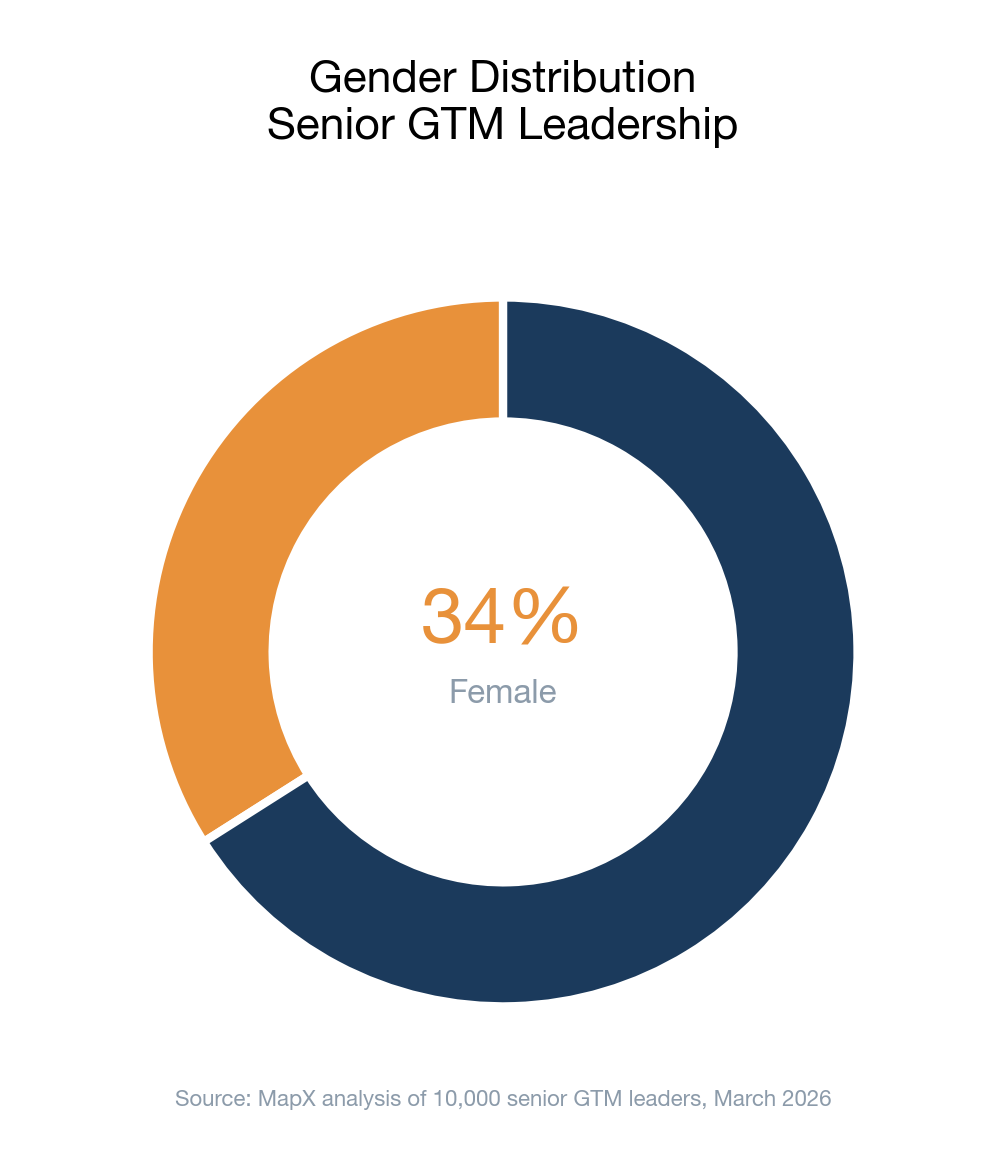
34% of senior GTM leaders in our dataset are female — notably higher than many senior leadership populations.
Gender Distribution
This is a pipeline story, not a sourcing story. The challenge for most companies isn't finding female commercial leaders — they exist in meaningful numbers. The challenge is retention: creating the conditions for them to stay and progress.
Signal vs Feasibility: Where Should You Actually Source?
The data reveals an irony: the "obvious" sources for senior GTM talent are oversubscribed, while the alternatives are underserved.
[CHART: ]
Technology companies (AWS, Google, Microsoft) have strong signal — the data shows leaders do come from these companies. But feasibility is low: everyone targets them, competition is fierce, response rates are poor, and compensation expectations are inflated.
Consumer goods companies have equally strong signal but better feasibility: fewer recruiters target them, competition is lower, and compensation expectations may be more manageable.
Consulting firms sit in an interesting position: moderate signal, high feasibility. These candidates are easier to engage but require careful assessment of their ability to execute, not just advise.
---
## What This Means for How You Hire
### For search strategy
Expand beyond technology companies — but do it strategically, not reflexively. Add consumer goods and consulting backgrounds when the role relevance justifies it. Accept that these candidates may need different onboarding and ramp time.
### For hiring managers
Be realistic about non-traditional backgrounds. A candidate from P&G brings different skills — structured commercial thinking, P&L discipline, multi-channel experience. That's valuable, but it requires a hiring manager willing to look beyond sector-specific experience.
### For talent leaders
Build pipelines proactively. The market is closed; reactive hiring fails at the senior level. Set realistic timelines (3–6 months minimum for senior commercial roles) and invest in employer brand.
And on diversity: the pipeline exists. Focus on retention, not just sourcing.
---
## Methodology
This analysis is based on a dataset of 10,000 senior GTM leaders from the MapX database, comprising 80,788 position records providing career history data. "Senior GTM leaders" includes CROs, CGOs, CMOs, VPs of Sales, VPs of Marketing, and equivalent commercial leadership roles at director level and above.
All data was sourced from MapX's proprietary database of 22 million+ leadership profiles, classified using a hybrid BERT + LLM architecture across 19 functions and approximately 400 specialisms.
---
This is the first in a series of talent intelligence reports from MapX. Next: Where CFO & Finance Leaders Come From.
For access to MapX data or to discuss this analysis, contact [amartin@mapx-ai.com](mailto:amartin@mapx-ai.com).