
Where GTM and Revenue Leaders Come From. And What That Means for How You Search
Executive Summary
This report analyses career histories for 10,000 senior GTM and Revenue leaders — 80,788 position records across 30+ countries — to show where this talent originates, how it moves, and what that means for search execution.
Three findings matter most:
CROs and CGOs come from different talent pools. Treating them as interchangeable produces mismatched longlists — consistently.
The majority of “best-in-class” talent has already exited these environments. The discipline is filtering for recency and trajectory to find the most attractive leaders.
The 34% female representation figure is misleading. Enterprise SaaS CRO roles sit closer to 15–20%. Consumer CGO roles meet or exceed 34%. Using the blended number sets unattainable targets for some mandates and unambitious ones for others.
Why This Market Matters
Senior GTM hires — CRO, CGO, Head of Commercial — fail or stall most often because the search was built on an underspecified brief or unchallenged assumptions about where the right candidate comes from.
Nearly every quality candidate at this level is employed, well-compensated, and not looking. Waiting for availability signals means competing for the same small pool of between-roles candidates every other firm has already called.
The question isn't whether to be proactive. It's whether the assumptions behind your proactivity are correct.
Methodology
GTM capability as a subset of broader commercial: ~10% of commercial leaders are in GTM type roles or remits
Population for this analysis: 10,000 senior GTM/Revenue leaders (C-level to Head of)
Records: 80,788 positions; average 8+ roles per person
Geography: 30+ countries; US = 52% of population
Focus: Feeder company patterns, role archetype differentiation, gender composition, career transferability
Key limitations: All frequency data is historical and cumulative — it reflects full careers, not current availability. Gender data may undercount non-binary identities. Correlation in career pathways is not causal.
Core Findings
1. CROs and CGOs draw from different talent supply chains
The most common sourcing mistake in senior GTM hiring is role definition.
Chief Growth Officer (CGO) titled leaders most frequently come from consumer goods and consulting — P&G (73 appearances), Unilever (65), Accenture (56). These organisations build integrated commercial leaders: brand P&L, customer acquisition, marketing strategy, category development.
Chief Revenue Officer (CRO) titled leaders come from enterprise tech and SaaS — Microsoft, Salesforce, AWS. These organisations build pipeline-focused revenue leaders: sales methodology, revenue operations, ARR accountability.
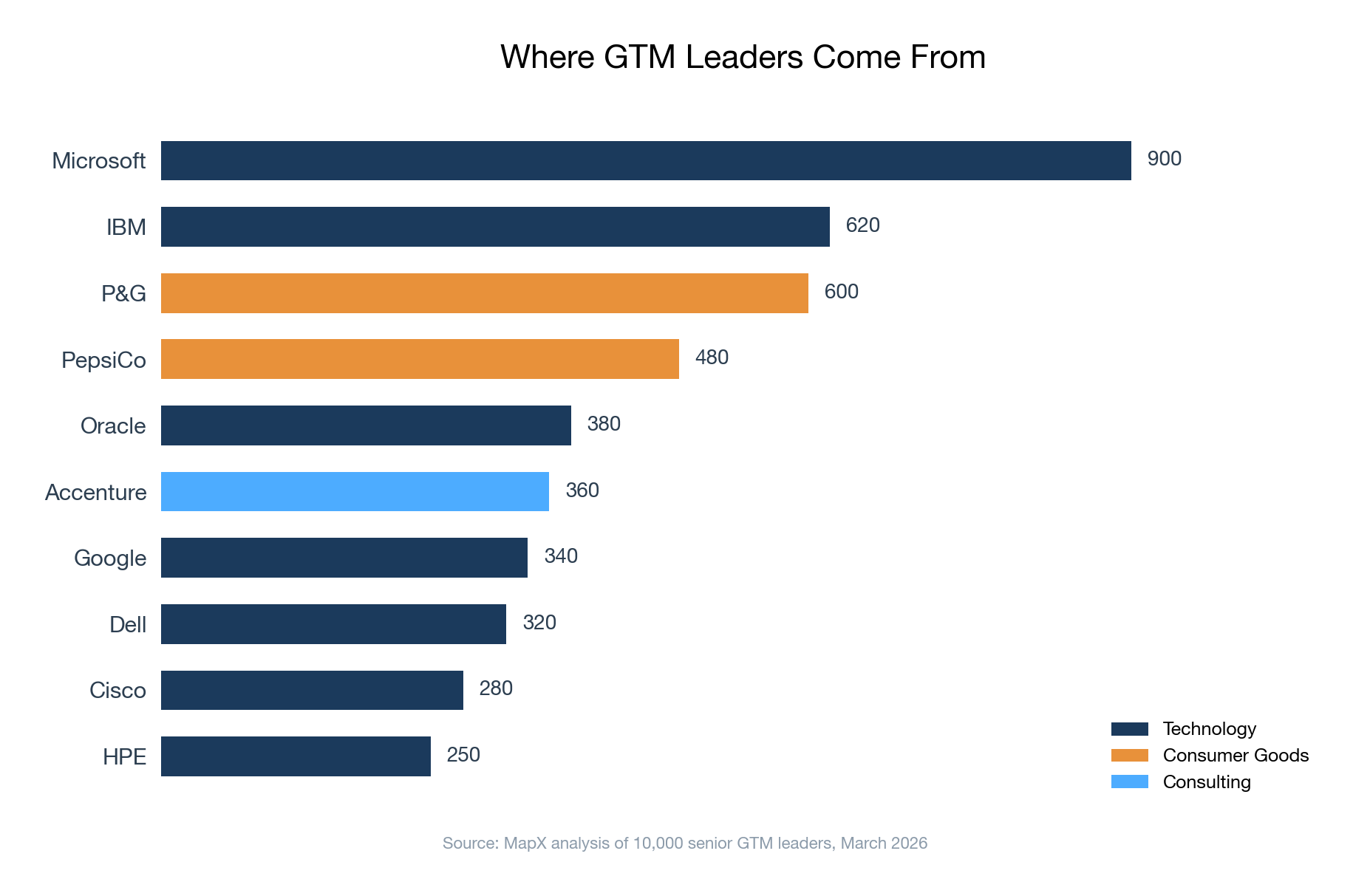
Where GTM Leaders Come From
Microsoft leads with 900 appearances across career histories. But the next tier isn't dominated by technology companies. Procter & Gamble (600), IBM (620), and PepsiCo (480) all feature prominently — ahead of Google (340) and Oracle (380).
Of 1,350 Chief Growth Officers in our dataset, the most common previous employers were P&G (70), Unilever (62), Accenture (52), Deloitte (45), and PepsiCo (43). Microsoft appears sixth.
Two distinct career patterns emerge: operating backgrounds (P&G, Unilever, PepsiCo, Danone) and consulting backgrounds (Accenture, Deloitte). Each brings different strengths and different risks.
Consulting backgrounds are typically easier to engage — these candidates are more open to change. But they carry a higher fall-off risk and can be too advisory vs execution focused.
Operating backgrounds are harder to engage but convert more reliably. The experience is directly relevant. The challenge is convincing hiring managers that category-specific experience (say, "Director of Sales, Fabric Care") translates to a different context.
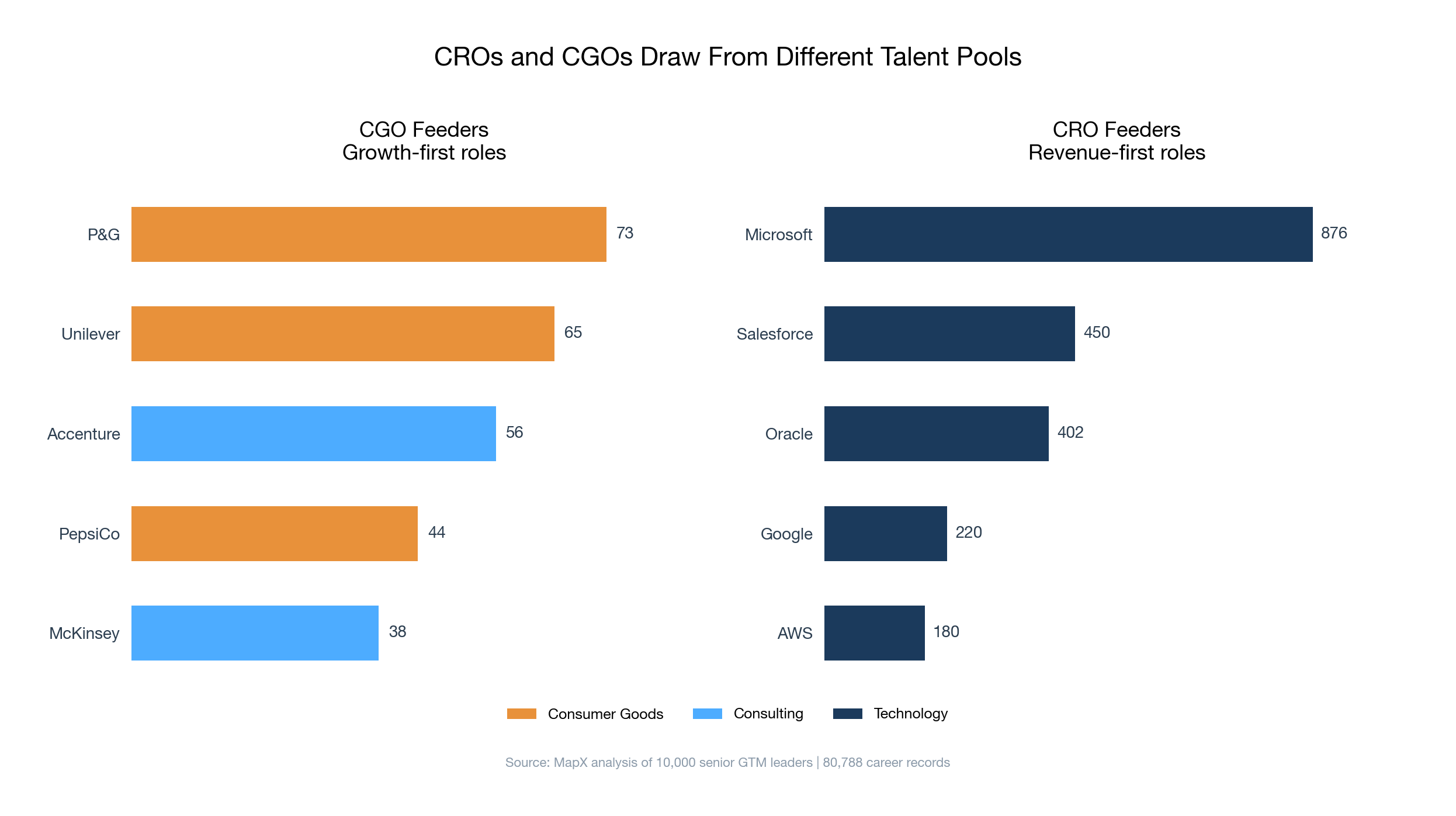
These pools barely overlap. When the brief isn’t clear whether the role is revenue-first or growth-first, the longlist serves neither need. Worse, organisations often pivot from CRO to CGO (or back) mid-search, wasting weeks of sourcing effort.
What to do: Treat brief calibration as sourcing, not admin. Three intake questions determine which supply chain to access:
Is this role revenue-first or growth-first?
What does execution look like in the first 90 days?
What P&L scope does the role own?
One structured briefing session saves several weeks.
2. The majority of “best-in-class” talent has already exited these environments
There’s an implicit assumption that the best candidates are still inside these organisations because they have the most up-to-date operating knowledge.
That breaks down in practice:
Current employees are harder to access and less likely to move
Their incentives are aligned with staying, not exploring
You are competing with internal progression and retention machinery designed to keep them
By contrast, individuals who have already left:
Have demonstrated willingness to move
Have translated “best-in-class” training into new environments
Are more likely to be in market or open to conversation
Often sit in roles where they’ve applied those playbooks, not just operated within them
In other words, you’re not just hiring pedigree. You’re hiring portability of capability. Instead of “current vs past”, our suggestion is to segment based on mobility and applied trajectory.
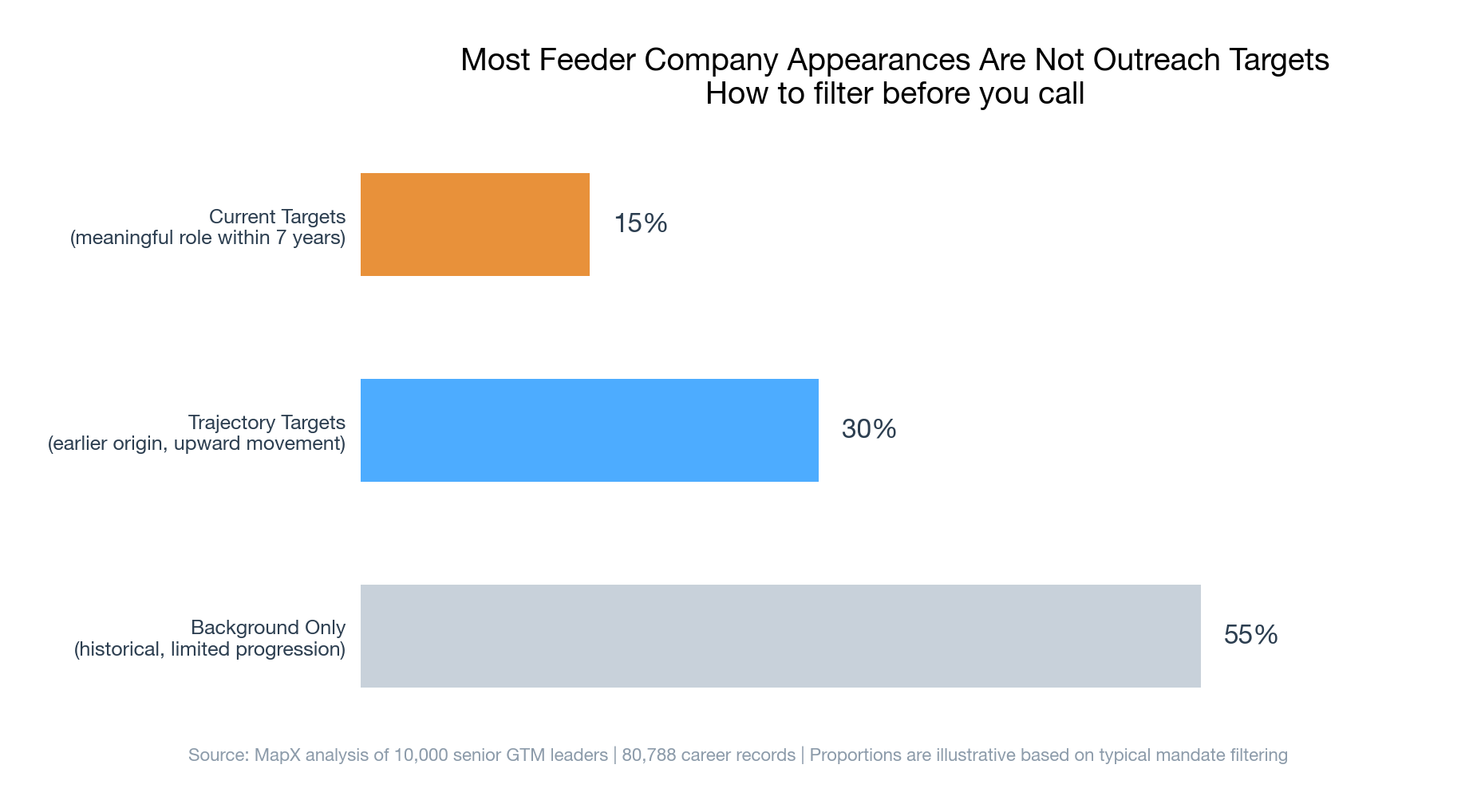
1. Proven leavers (primary targets)
Left a recognised GTM environment and progressed into senior roles elsewhere.
Highest likelihood to engage
Evidence of adapting playbooks beyond the “mothership”
Typically where the best conversion happens
2. Translators (high-value, selective)
Moved from top-tier firms into different contexts and successfully scaled or transformed functions.
Strong signal of real operating capability
Particularly valuable for scale-ups or transformation mandates
3. Current incumbents (precision use only)
Still inside Microsoft, P&G, etc.
Useful for targeted outreach, not volume hiring
Better used to validate how current GTM systems operate
Occasionally viable, but expect low response rates and long cycles
4. Background-only (context, not candidates)
Historic affiliation without meaningful progression.
Useful for pattern recognition
Low priority for outreach
The practical implication
If you build a search strategy around current employees of “best-in-class” companies, you’re optimising for brand proximity, not hireability.
A more effective approach is to anchor your search on individuals who have already left and progressed, layer in a small number of current incumbents to fill knowledge gaps and prioritise evidence of applied success over institutional pedigree.
3. Gender diversity varies sharply by role type
The dataset shows 34% female representation across all 10,000 leaders — above typical C-suite benchmarks of 20–25%.
But this aggregate hides significant variation:
- Enterprise SaaS CRO roles (sales-led, ARR-focused): around 18% female representation
- Consumer CGO and CMO roles (brand-led): around 38%
This difference is structural, driven by the different supply chains for these roles. It means that for a Enterprise SaaS type hire, achieving a gender diverse balanced shortlist will be a challenge. Whereas for a Consumer CGO or CMO role it is much more realistic.
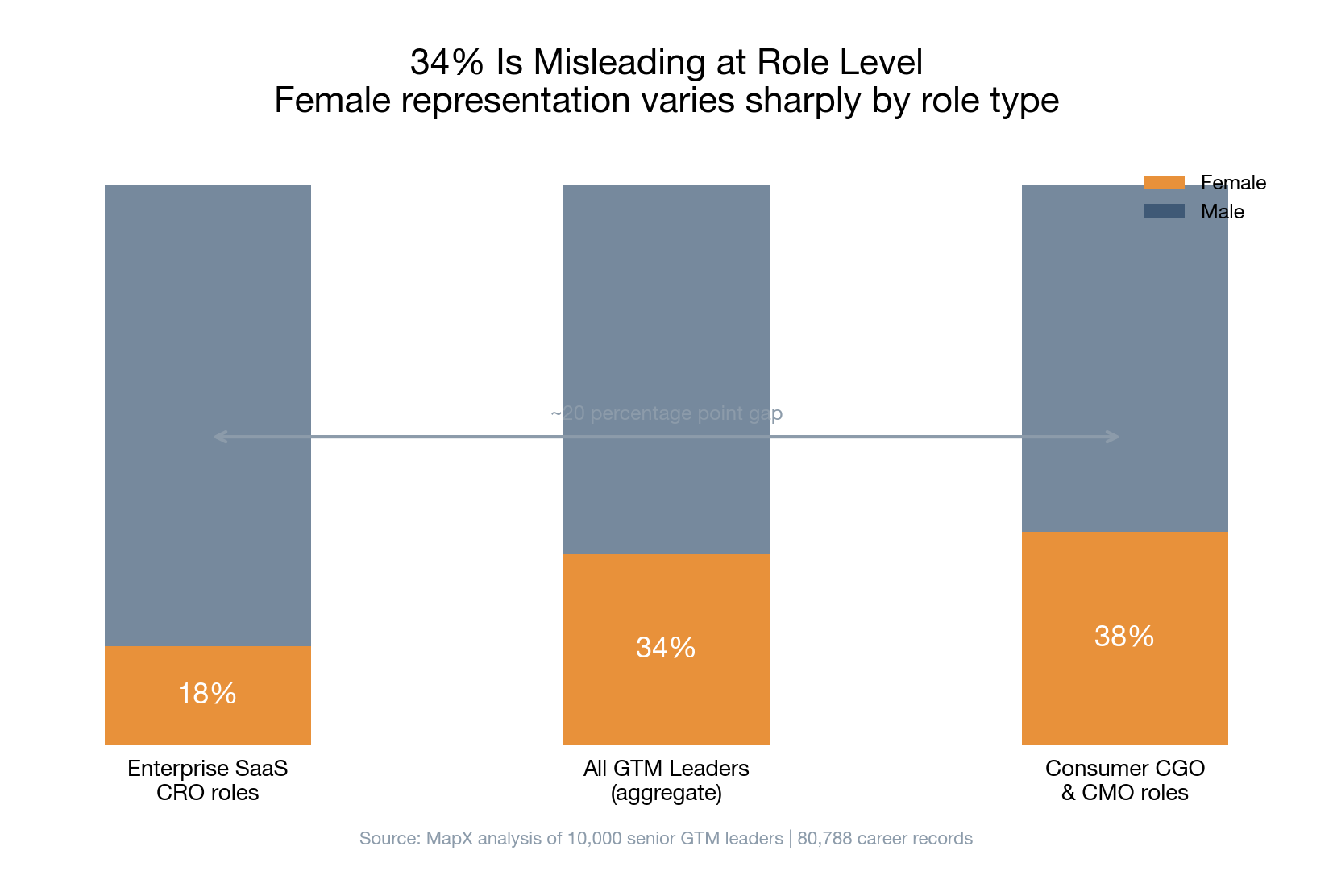
The problem with using 34% as a blanket target: For an enterprise SaaS CRO search, the number of gender diverse candidates is particularly limited. so the team creates quiet exceptions rather than addressing the real constraint. For a consumer CGO search, it may be unambitious.
4. Understanding the differences between Consumer Goods and Consulting pathways
Consumer goods and consulting backgrounds need explicit validation
CG and consulting backgrounds are genuinely upstream of CGO roles. But they carry specific failure modes that interviews often miss.
Consulting backgrounds — the strategy-to-execution gap:
Consulting builds framework sophistication, client skills, and analytical depth. It rarely builds sustained P&L ownership — setting price, managing margin, owning retention, being accountable for results you can't delegate. The gap between advising and owning is wide, and it shows under execution pressure. Polished interview performance masks it.
What to probe: Evidence of sustained, documented ownership of a revenue line. Not project-level commercial exposure within a client engagement.
Consumer goods backgrounds — the environmental gap:
Senior CG leaders are formed in environments with large budgets, big teams, established channels, and multi-year planning cycles. None of this transfers to a growth-stage B2B SaaS company with quarterly urgency, constrained headcount, and an ambiguous GTM structure. The gap typically becomes visible within 6–12 months.
What to probe: Speed-to-ambiguity tolerance, performance under resource constraints, comfort operating without team infrastructure. Reference processes should test these explicitly.
Derailers for GTM Search Strategy
Four things consistently derail the translation from insight to execution:
The comp gap is a sourcing constraint, not a negotiation problem. Senior CG leaders at CGO level operate in £350k–500k+ total comp environments with long-term incentives tied to brand P&L. Scale-ups offering equity instead of cash will rarely win these candidates. Before committing sourcing effort, resolve the comp architecture. If a credible package can't be built, the realistic target is the next tier down — Directors or Regional GMs with motivation and headroom to step up.
Brief ambiguity compounds — it doesn't resolve itself. Each week of sourcing against an unclear brief extends time-to-hire, increases candidate exposure risk, and makes the eventual pivot more disruptive. A structured intake costs hours. Brief drift can cost months.
Diverse shortlist vs diverse longlist. Identifying enough female leaders within each pool to have representation at longlist stage (pre-engagement) is viable, however the drop off to shortlist is likely to be significant. So it’s important to consider what you are internally committing to.
Search Playbook
So pulling this all together, what does it mean for search strategy with the GTM space?
For CRO mandates:
Source from enterprise tech and SaaS — Microsoft, Salesforce, Google, AWS alumni; consulting exits with documented commercial line ownership
Filter feeder data by recency and trajectory before outreach
Model unvested equity as a counter-offer risk at shortlist stage, not offer stage
For CGO mandates:
Lead with consumer goods and consulting alumni — P&G, Unilever, PepsiCo, McKinsey growth practice, Accenture
Validate comp architecture before sourcing begins
If a comp gap exists, redirect to Director/Regional GM level in the same companies
Reference-check specifically for speed-to-ambiguity and resource-constraint performance
For both:
Run a structured intake to resolve role archetype before sourcing starts (ideally examples of individuals who arcehtype these pathways)
Frame around execution: first-90-day deliverables, P&L scope, team structure, comp envelope
Set diversity targets by sub-function, not aggregate benchmarks
This is the first in a series of talent intelligence reports from MapX. Next: Where CFO & Finance Leaders Come From.
For access to MapX data or to discuss this analysis, contact [amartin@mapx-ai.com](mailto:amartin@mapx-ai.com).