
2026 Talent Mapping Software Comparison for Executive Hiring
If you run an in-house executive search or talent acquisition function, you already know what the problem is.
You have LinkedIn Recruiter. You have a team. You have a process. And yet, every senior search still starts with the same uncomfortable questions: will we actually be able to find sufficient numbers of the people we’re being tasked to identify? And how long is it going to take?
You have instinct, network knowledge, and whatever your team has seen recently. But you rarely have structured data about the size of the qualified pool, the realistic trade-offs in the brief, or the evidence you need to align a hiring manager before two weeks of desk research produces a list that may or may not work.
That is the problem talent mapping software is designed to solve. The front end: understanding the market well enough to run a search that works the first time while speeding up the desk research phase.
This guide covers how talent mapping software fits into the executive recruitment process, what the landscape looks like in 2026, and how to evaluate platforms for senior-level work.
Where talent mapping software fits in the executive hiring process
Executive hiring runs through distinct phases. Most software only helps with some of them. Knowing where the value sits - and where it doesn't - is the difference between a useful investment and an expensive database.
Brief formation and market testing
This is where most searches are won or lost. A brief is a wish list. The question talent mapping software should answer immediately is: how many people actually meet those criteria, and what happens to the pool when you adjust them?
Good platforms let you test brief viability in hours. They show total pool size, which criteria are common versus rare, where latitude exists in adjacent industries or functional pathways, diversity splits, feeder company patterns, and location density. Without this, you are hoping the desk research phase produces enough viable candidates to sustain the funnel. If it doesn't, you restart.
Identification and filtering
At executive level, the challenge is not just finding names. It is distinguishing between people whose titles look right and people whose underlying experience actually fits. That means matching relevance by career shape, org context, functional specialism, and seniority - not just keywords.
Hiring manager calibration
This is the most undervalued phase - and the one where talent mapping software makes the biggest practical difference.
The hiring manager is your internal customer. They have a mental model of who they want, usually anchored to one or two reference points. Your job is to translate that into a structured, evidence-based market view.
This is where a reporting layer helps. The best platforms produce structured outputs that show:
Total addressable pool for the agreed criteria
Diversity breakdown segmented by industry and geography
Feeder company analysis — which organisations produce candidates for this type of role
Criteria sensitivity — "drop X, pool triples; insist on Y, it halves"
Location density and mobility implications
Seniority and tenure patterns
When you put this in front of a hiring manager in week one rather than week four, the entire dynamic changes. Evidence compresses alignment, prevents wasted research cycles, and makes the funnel viable from the start.
Prioritisation and stakeholder-ready output
Once the market is understood, the team needs to produce ranked, structured candidate views. C-suite hiring managers and their stakeholders will have almost certainly worked with major global search firms in the past - either as a client or a candidate. They expect consultancy-grade output: structured profiles, market landscape summaries, progress updates that look credible in a board conversation.
Most exec TA teams currently produce these by exporting from a CRM (which rarely looks good) or manually building PowerPoint decks (which is slow and a poor use of skilled professionals' time). During a live search with two or three updates, this becomes a serious time drain.
Good talent mapping software should make it straightforward to generate quality reports on demand, at pace, and in a format appropriate for the audience. At executive level, the fit and finish of your outputs is part of how the hiring function earns credibility internally.
Engagement onward
Talent mapping software mostly drops off here. This phase belongs to CRM tools, ATS systems, and human judgment. But the quality of everything upstream directly determines whether the engagement phase works.
LinkedIn Recruiter: essential infrastructure, insufficient methodology
You already know the limitations. Title interpretation is unreliable at senior level. There is no career-shape filtering, no org-chart visibility, no market-sizing capability, and no structured output for stakeholders. The algorithm skews your results by who you are connected to and who you last looked at. Which penalises exactly the senior executives you want to find. Benchmark testing the same search criteria within the same organisation by two different license holders can create up to a 20% disparity in total population size, diversity statistics are different and the ordering of candidates is different (with some not visible at all).
LinkedIn Recruiter is still necessary. But at executive level, these gaps become a real problem. The question is what you layer on top of it.
The talent mapping software landscape in 2026
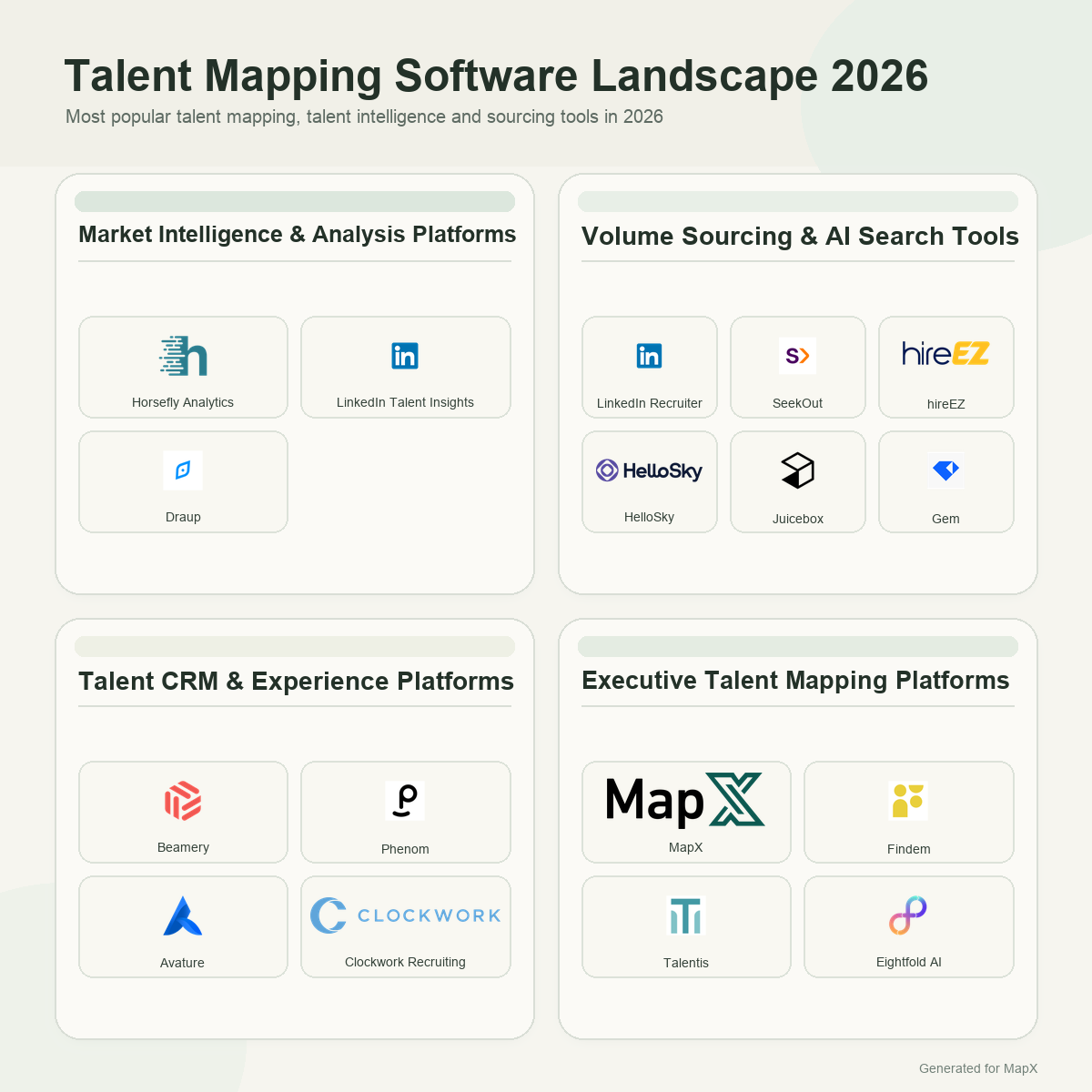
Not all tools in this space do the same thing. Most were built for volume hiring. The landscape breaks into four practical categories.
1. Market intelligence and analytics platforms
These answer "what does the market look like?" at an aggregate level -workforce planning, location strategy, salary benchmarking, competitive intelligence. They do not identify individual candidates.
Horsefly Analytics — the strongest pure market-intelligence platform. Aggregates labour market data from job postings, census, and government sources. Useful for workforce planning and macro talent trends. Enterprise pricing. No individual profiles — analytics only.
LinkedIn Talent Insights — aggregated workforce data from the LinkedIn graph. Useful for high-level trends and competitive benchmarking. Add-on to LinkedIn enterprise contracts. Not operational — you cannot identify individuals.
Draup — AI-driven talent intelligence with skills analysis, peer benchmarking, and workforce modelling. Enterprise SaaS with dedicated account management. Suited to large enterprises doing skills-first workforce planning. Heavier than most teams need for day-to-day executive search.
2. Volume sourcing and AI search tools
These find individual candidates fast. Optimised for throughput — large databases, broad filters, candidate lists at scale. They work for mid-level and technical hiring. They are weaker for executive search where nuance matters more than volume.
SeekOut — 750M+ profiles with deep filters including security clearances, patents, and GitHub activity. Strong for technical and US government recruiting. Enterprise pricing (~$10K+/seat/yr). Steep learning curve, US-centric data. Not designed for C-suite mapping.
hireEZ (formerly Hiretual) — 800M+ profiles from 45+ platforms. Solid Boolean engine. Tiered SaaS (from ~$170/mo to enterprise). Good for high-volume teams and agencies. No career-shape intelligence or org-chart view.
Juicebox (PeopleGPT) — natural language search: "find me a CFO who scaled a fintech from Series B to IPO." Quick and accessible, freemium to paid. Better for straightforward sourcing rather than strategic executive mapping.
Gem — started as a recruiting CRM, expanded into sourcing and pipeline analytics. ~$3,600–$4,000/seat/yr. Good for mid-to-large TA teams consolidating tools. Operationally focused — not a strategic mapping platform.
3. Talent CRM and experience platforms
These manage candidate relationships, pipelines, and workflows. Valuable once you have candidates in your system. They do not do external market identification or mapping.
Beamery — best-in-class talent CRM. Excellent for proactive pipeline building and passive candidate engagement. Enterprise SaaS (six-figure annual). Requires an existing pipeline to add value. Not a sourcing or mapping tool.
Phenom — talent experience platform covering career sites, CRM, AI matching, and chatbots. Enterprise SaaS. Built for high-volume employers. Not a strategic mapping tool.
Avature — highly configurable enterprise CRM and workflow engine. Powerful but complex, requiring significant implementation investment. Used by large enterprises and RPOs. Not a market intelligence tool.
Clockwork Recruiting — process management for retained executive search firms. Structured project management, client portals, reporting. Per-user SaaS. Manages the search workflow but does not identify candidates or map markets.
4. Executive-level talent mapping platforms
These are specifically built for the requirements of senior hiring: classification beyond keywords, career-shape intelligence, org-chart visibility, and stakeholder-ready outputs. This is the smallest category.
MapX — MapX is a talent mapping platform built specifically for executive-level hiring. It is designed around four core capabilities:
Intelligent sourcing: AI-powered candidate identification tuned for executive search. MapX uses structured role categorisation -not keyword matching - to surface candidates based on function, specialism, seniority, and career trajectory. Features include company target list expansion, organisational charts, and AI-powered talent suggestions.
Executive search-grade candidate screening: AI screening at approximately 100 candidates per minute, built to evaluate fit at senior level - factoring in career shape, org environment, and role-specific relevance rather than surface-level title matching.
Role-specific data and insights Structured market intelligence including talent pool sizing, diversity analytics, feeder company analysis, industry distribution, and advanced data categorisation for enterprise intelligence teams. Designed to support brief calibration, hiring manager alignment, and board-level talent conversations.
Accelerated reporting Fast generation of custom branded PowerPoint-ready reports. Market maps, candidate packs, and talent landscape summaries produced at pace - without the hours of manual assembly that typically consume skilled research professionals' time.
MapX customers also have access to a team of executive search-trained researchers who provide hands-on project support - from brief calibration and scope adjustment to profile validation and market interpretation.
Findem — attribute-based search with career trajectory intelligence and org-chart data. Enriches profiles from multiple sources. Explicitly markets executive search as a use case. Enterprise SaaS. A newer entrant with a growing but smaller customer base. Org-chart data quality varies by company and region.
Talentis — serves boutique and mid-size executive search firms with AI-driven search, minimal data entry, and self-cleaning data. Uses OpenAI and Perplexity. Per-user SaaS. Primarily a search-firm tool rather than an in-house TA platform.
Eightfold AI — the deepest AI for skills inference and career pathing, with 1.6 billion profiles. Strongest on internal talent intelligence and skills-based workforce planning. Enterprise SaaS (six-figure annual, lengthy implementation). Less purpose-built for bespoke external executive search — best ROI for large enterprises with significant internal mobility programmes.
How to evaluate talent mapping software for executive hiring
Use criteria that reflect how executive search actually works — not generic feature grids.
1. Test title interpretation, not search speed
Give the platform a genuinely messy brief - overlapping titles, adjacent sectors, imperfect signals. See which one gets you to a credible target market fastest. If it cannot distinguish between two people with identical titles but fundamentally different backgrounds, it is not suited for senior search.
2. Ask whether it supports calibration, not just sourcing
Can the tool help you have a better conversation with a hiring manager? Does it produce market-sizing data, trade-off analysis, diversity breakdowns, and feeder-company intelligence? Or does it just give you a list of names?
3. Evaluate output quality and speed
Can the platform produce something a CHRO, CEO, or board member can use without hours of manual reformatting? Market maps, talent landscape reports, structured candidate profiles? During a live search, can you regenerate updated outputs quickly as the picture evolves?
4. Evaluate classification quality
How does the platform handle job titles? Does it rely on keywords, or does it classify by function, specialism, and seniority using a structured framework? At executive level, this is the most consequential technical capability.
5. Consider the service model trade-off
Pure software is faster and cheaper but requires strong internal research capability. Hybrid models - technology plus human validation - deliver higher accuracy but cost more and take longer. Full-service is the most hands-off but the most expensive. Match the model to your team's capacity and the complexity of your searches.
6. Look at current relevance, not historical noise
Many platforms surface anyone who has ever touched a relevant company or title. At executive level, you need current relevance, people whose recent trajectory makes them a realistic target now.
7. Understand pricing and implementation reality
Expect significant variation. Volume sourcing tools range from a few thousand per seat per year to enterprise pricing. Market intelligence and CRM platforms are typically six-figure annual commitments. Executive-specific platforms vary between per-project and annual access models. Implementation complexity ranges from plug-and-play to months of configuration. Factor this into your business case - the right tool at the wrong price or implementation timeline is still the wrong decision.
What to do next
If you are evaluating talent mapping software for your executive hiring function, three steps are worth taking now:
1. Map your current process against the phases above. Where are you spending the most time? Where do searches break down? That tells you which category of tool will deliver the most value.
2. Test with a real brief, not a demo scenario. Give two or three platforms a genuinely complex search brief and compare what comes back. The quality of results on a messy, realistic brief is the most revealing test.
3. Be honest about what you need. If your team has strong internal research capability and you mainly need better data inputs, a market intelligence platform may be enough. If you need help with classification, calibration, and stakeholder-ready outputs at senior level, you are looking at the executive mapping category - and the options there are genuinely limited.
The landscape in 2026 still largely features tools built for volume recruitment with some AI features layered on top. Some have useful data capabilities, but they are too general to serve the specific demands of senior leadership hiring - where career shape, org context, classification accuracy, and output quality all matter far more than database size.
Very few platforms are purpose-built for executive-level talent mapping. The ones that are tend to share a common design philosophy: they treat the front end of the search - strategy, calibration, market intelligence - as the highest-value phase, not an afterthought.