About
Born inside a search firm
Five years ago, inside an executive search firm, we bet that AI could learn the technical side of candidate research if it was trained properly. Today MapX runs on live searches every day, as part of 6 Group.

Why we built it
The most skilled, slowest job in search
Against any brief, someone has to find the 50 to 100 people most worth approaching. It is expert work, and it takes days. So we paired researchers and search professionals, whose careers include Korn Ferry, Spencer Stuart, Egon Zehnder and Heidrick & Struggles, with engineers and data scientists, and turned the way they research into a system software can run.
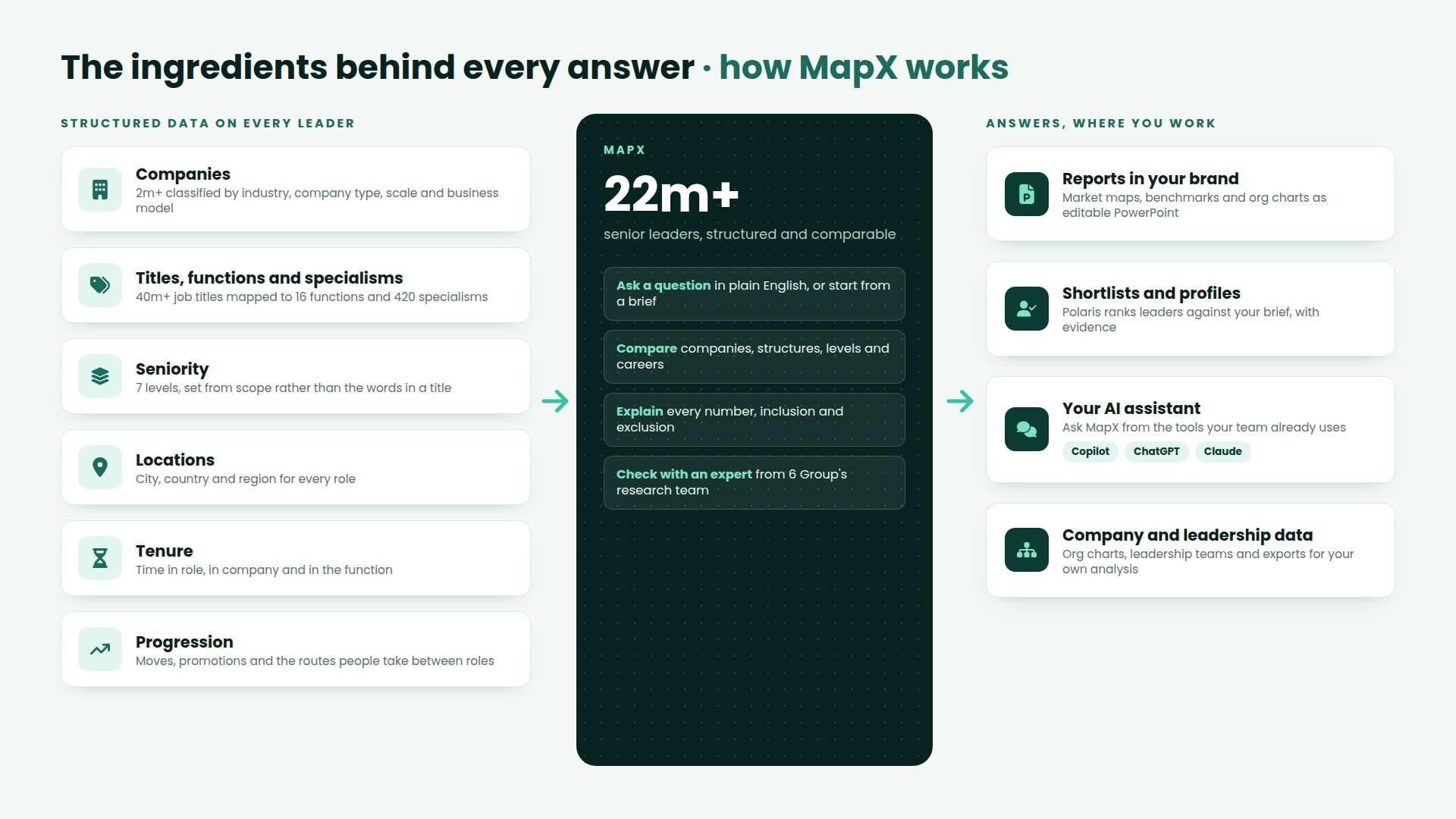
The idea was simple. The judgement about who to approach belongs to people, but the technical work underneath it can be learned: which companies are relevant, which roles are equivalent across them, how senior a title really is, and whose career matches the brief. Done properly, that work is consistent, explainable and fast.
Today the research that took a search team days runs in hours, and the people who used to build spreadsheets spend their time talking to candidates and clients.

Practitioners, not observers
We use MapX on live searches every day
Unlike most companies in this space, we deliver executive search ourselves. MapX was built over four years inside Savannah Group, refined on hundreds of live search and talent intelligence projects, and is now part of 6 Group. Every assignment, from market maps to succession, organisation design and competitor benchmarking, feeds back into the product.
That means MapX is tested where it counts: on real briefs, against real hiring managers’ expectations, by people accountable for the result. Alongside executive search we run a talent intelligence business, so market mapping, succession benchmarking and competitor analysis are work we deliver for clients every week.
Why we built our own models
We adopted large language models early, and hit their limits quickly. They are probabilistic, so they cannot classify 40 million job titles the same way every time. MapX pairs classification models we built ourselves with LLMs, using each where it performs best.
In a blind benchmark set by a human expert, a frontier LLM classified job titles correctly 62.5% of the time; MapX scored 82.5%. And because presentation matters in search, every answer becomes an editable, search-firm quality report in minutes, not hours in PowerPoint.
For your team that means the same answer every time you ask, every inclusion and exclusion explained, and reports ready to share in your brand or straight from Copilot, ChatGPT or Claude.
See MapX on one of your own roles
Book a 45-minute demo. Bring a live search or a talent question and we’ll show you what MapX finds, and what you’d get.