
Who could do this role, beyond the usual names?
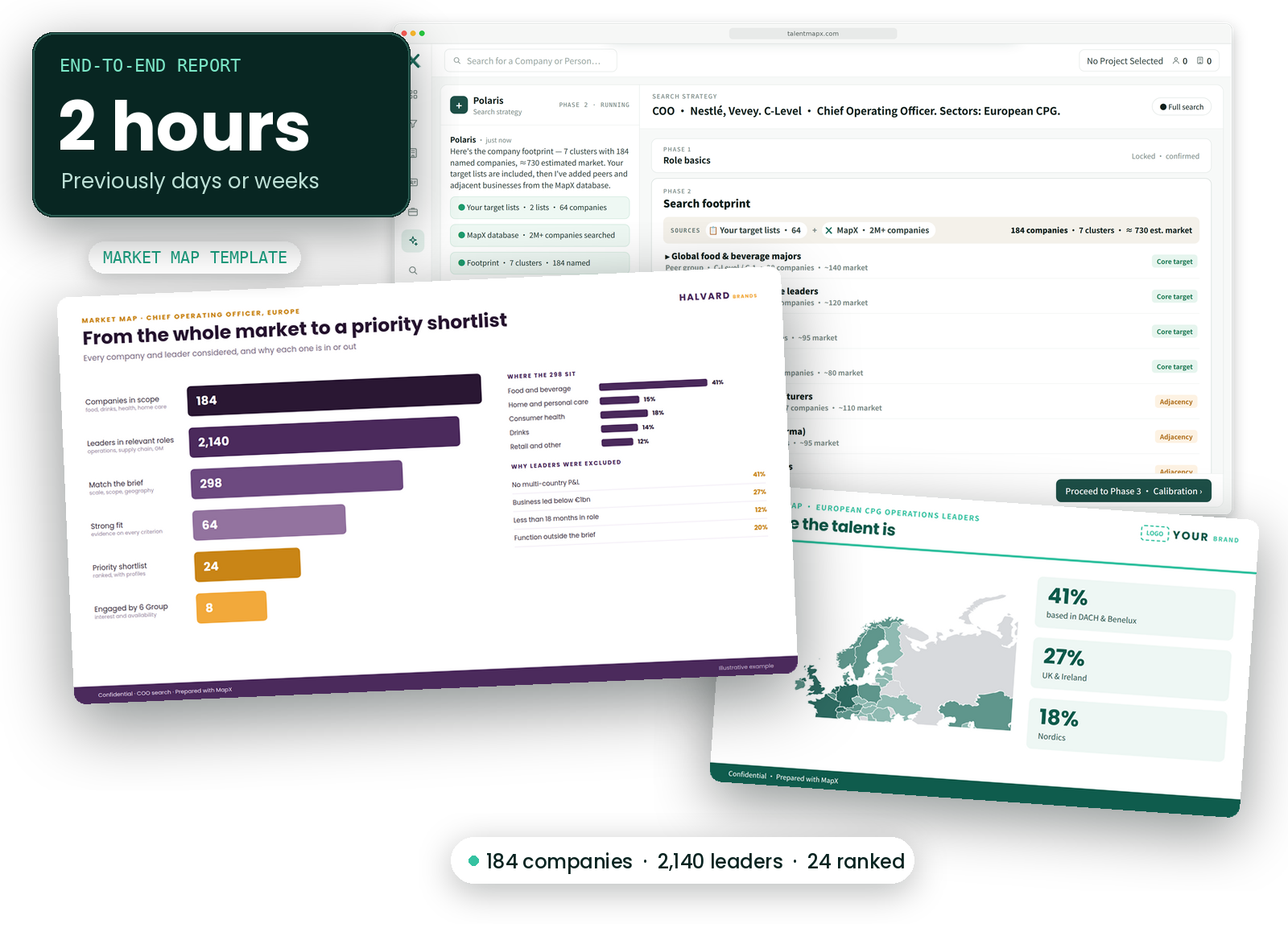
Map every company and leader relevant to a senior role, with the reason each one is in or out. Then turn the map into a ranked shortlist your hiring manager can act on.
THE PROBLEM
Your network only shows who you already know
Internal records and past searches show the candidates you have met before. Keyword searches miss leaders doing the same job under a different title, in an adjacent sector or in another language.
Executive market mapping fixes that by starting with companies rather than CVs. MapX builds the target company list for your brief, finds every leader in scope at each one and ranks them against your criteria, so the shortlist comes from the whole market rather than the part you already knew.
Your ATS and CRM hold the people you have already met.
Keyword and network searches return profiles one at a time, with nothing to compare them on.
A market map from a search firm takes weeks and arrives once.
MapX maps the market in hours, shows why each person is in or out, and can be rerun whenever the brief changes.
Questions it answers
Which companies should we target? Start from the sectors and company profiles that fit the role, including adjacent sectors you might not have considered. Every target company is classified the same way, so the list can be justified to a hiring manager.
How big is the realistic talent pool? See how many leaders genuinely fit the brief, not how many share a job title, and how that pool changes if you widen the sector, the location or the seniority band.
Who are the strongest leaders, and why? Every leader is ranked against your criteria with the evidence behind the ranking, and every exclusion carries its reason, so the shortlist stands up to scrutiny.
Who is likely to move? Tenure and career pattern show who has been in role long enough to consider a change, so outreach starts with the people most likely to answer.
-

Which companies?
Which companies should we target, and which adjacent sectors are worth a look?
-

How big is the pool?
How big is the realistic talent pool for this role, and how diverse is it?
-

Who is strongest?
Who are the strongest leaders, ranked against our brief, and why was each person in or out?
-

Who might move?
Which leaders have been in role long enough to consider a move?
The ingredients behind the answer
Every company and career in MapX is classified the same way. Combine the ingredients and the answer gets sharper. Polaris does this for every search.
For a market map, you set the target companies, functions, seniority and locations, and MapX narrows the market one ingredient at a time, showing how many leaders remain at each step and why the rest dropped out.
-

Companies
Build the target universe by industry, company type, scale and business model.
-

Functions
Find the role by what people do, in 11 languages, not by title keywords.
-

Seniority
Compare like with like across seven levels set by scope, not job title.
-

Tenure
See who has been in role long enough to consider a move.

What the output looks like
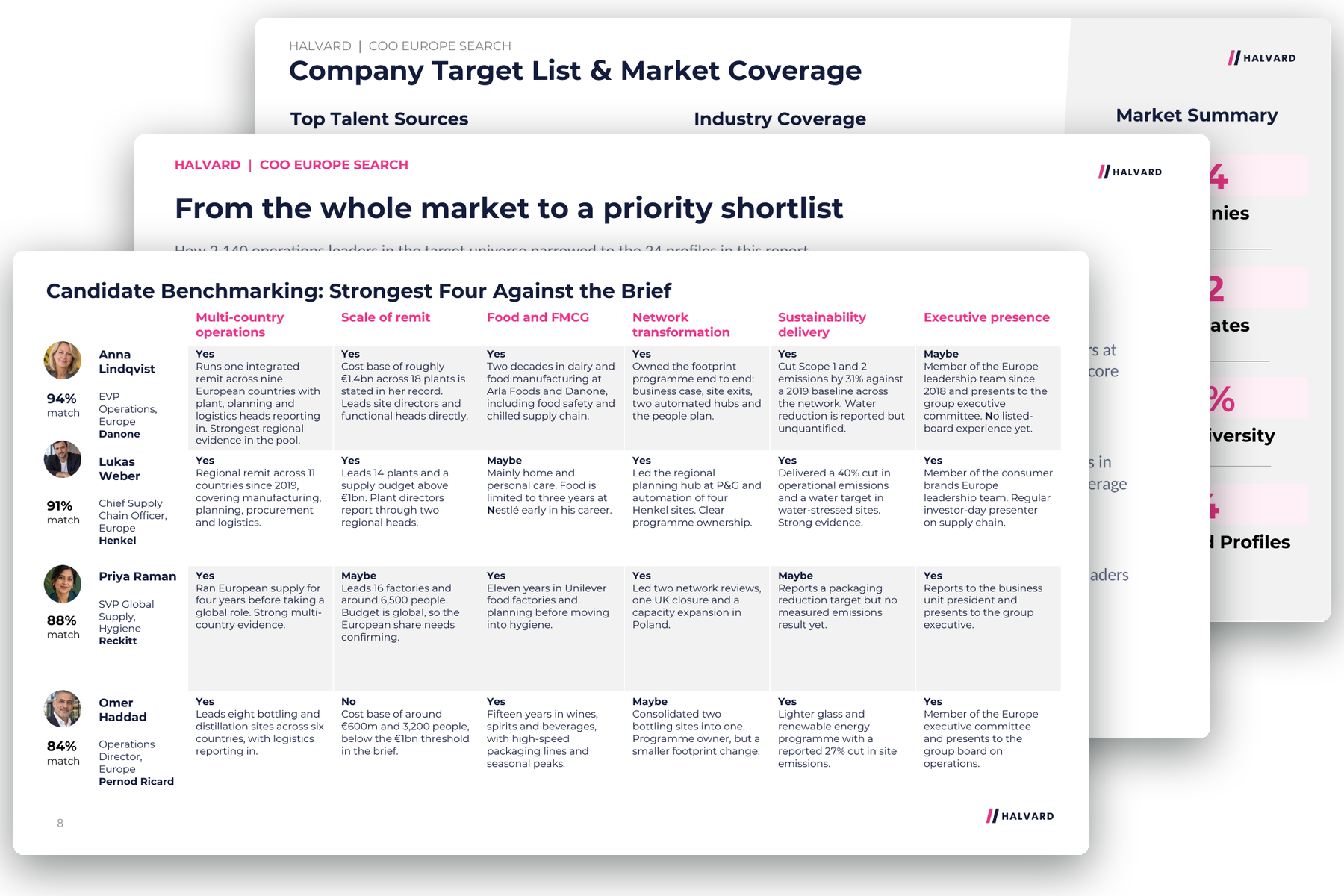
From the whole market to a priority shortlist: a company target list, a market map with the numbers at every step, and profiles of the leaders to meet first. Shown in a client's brand, with illustrative data and fictional people.
A company target list, split into core targets and adjacent sectors
A market map with the numbers at every step, from the whole market to the shortlist
Profiles of the leaders to meet first, with the evidence against each criterion
Teams use it to agree the search with the hiring manager in the first meeting, to brief a search firm when they use one, and to keep a live map of the market for the next time the role opens.
+30%
More candidates found per brief
+20%
More diverse shortlists
2 to 4 weeks
Faster to shortlist
400 hours
Saved in six months by a team of five
What MapX customers say
“Faster stakeholder calibration, broader and more diverse shortlists, and reporting we can take straight to the C-suite.”
VMO2 · Managed executive search
“Org charts and market maps that used to take days of analyst time are now produced in an afternoon.”
Aston Martin · Talent intelligence
“We can confidently run executive searches in markets and functions where we have no resident expertise.”
Bacardi · In-house executive search
Questions teams ask
What teams ask before their first market map.
How fast is a market map?
Most teams have a first view of the market the same day. The full map, with every leader ranked and every exclusion explained, follows in hours, ready for your review.
How many target companies can a map cover?
As many as the brief needs. A typical senior map covers 100 to 200 target companies across core and adjacent sectors, and you can add or remove companies at any point.
Why not use keyword search?
Keyword tools match the words in a job title. MapX classifies every company and career the same way, so it finds leaders doing the job under a different title, and explains why each person is in or out.
Can we use our own target company list?
Yes. Start from your own list, from MapX’s suggestions, or a mix. Every company is then mapped the same way, so the numbers compare.
Does it work for global roles?
Yes. MapX covers 22m+ senior leaders worldwide and reads job titles in 11 languages, so a map can span regions without losing the leaders who describe their roles in another language.
How is diversity shown?
Expected diversity is estimated from first names only, using census data for each geography. Nothing else about a person is guessed or used, and the method is set out on the Trust page.
How do we get started?
Two calls: one to set up your report library in your brand, and one to run a first market map together on a live role.
Can 6 Group approach the candidates?
Yes. When you want people on the ground, 6 Group’s researchers can validate the map, approach candidates and screen interest, using credits on your licence.
Map the market for your next senior role
Book a 45-minute demo. Bring a live search or a talent question and we'll show you what MapX finds, and what you'd get. Or start with the free sample pack: three finished reports in a client's brand.