Polaris
The AI researcher that runs your search like a search firm
Polaris takes a senior brief through the six steps a good researcher follows, from target companies and calibration to a ranked shortlist and a report in your brand. You guide every step, and every name comes with the reason it is in or out.
Polaris, the AI executive researcher
Works the way a search researcher works
Six steps, with you in control at each one. Research that takes days, done in under an hour, with human review.
How Polaris runs a search
Six steps, the same ones a senior researcher follows. You review and steer each one before Polaris moves on, so the shortlist reflects your judgement, not just the model’s.
-
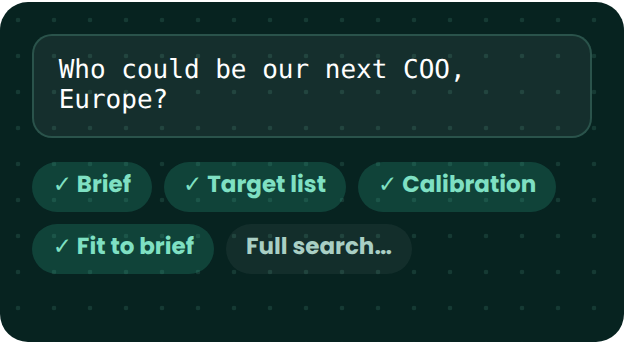
Share the role, the context and what good looks like. Polaris turns it into a structured brief: function, seniority, scope, locations and the experience that matters, ready for you to check before anything is searched.
-
Polaris proposes the companies worth searching, chosen on structural signals such as sector, size, ownership and business model, not just names you already know. Add your own lists, remove any you want to avoid, and agree the target list.
-
Before the full search, Polaris shows a small set of example profiles, including some that test the edges of the brief. Your reactions sharpen what fits and what does not, the way a researcher calibrates with a hiring manager.
-
The calibrated brief becomes clear scoring criteria, weighted the way you choose. Every candidate is later scored against the same criteria, so the ranking is consistent and easy to explain to the hiring manager.
-
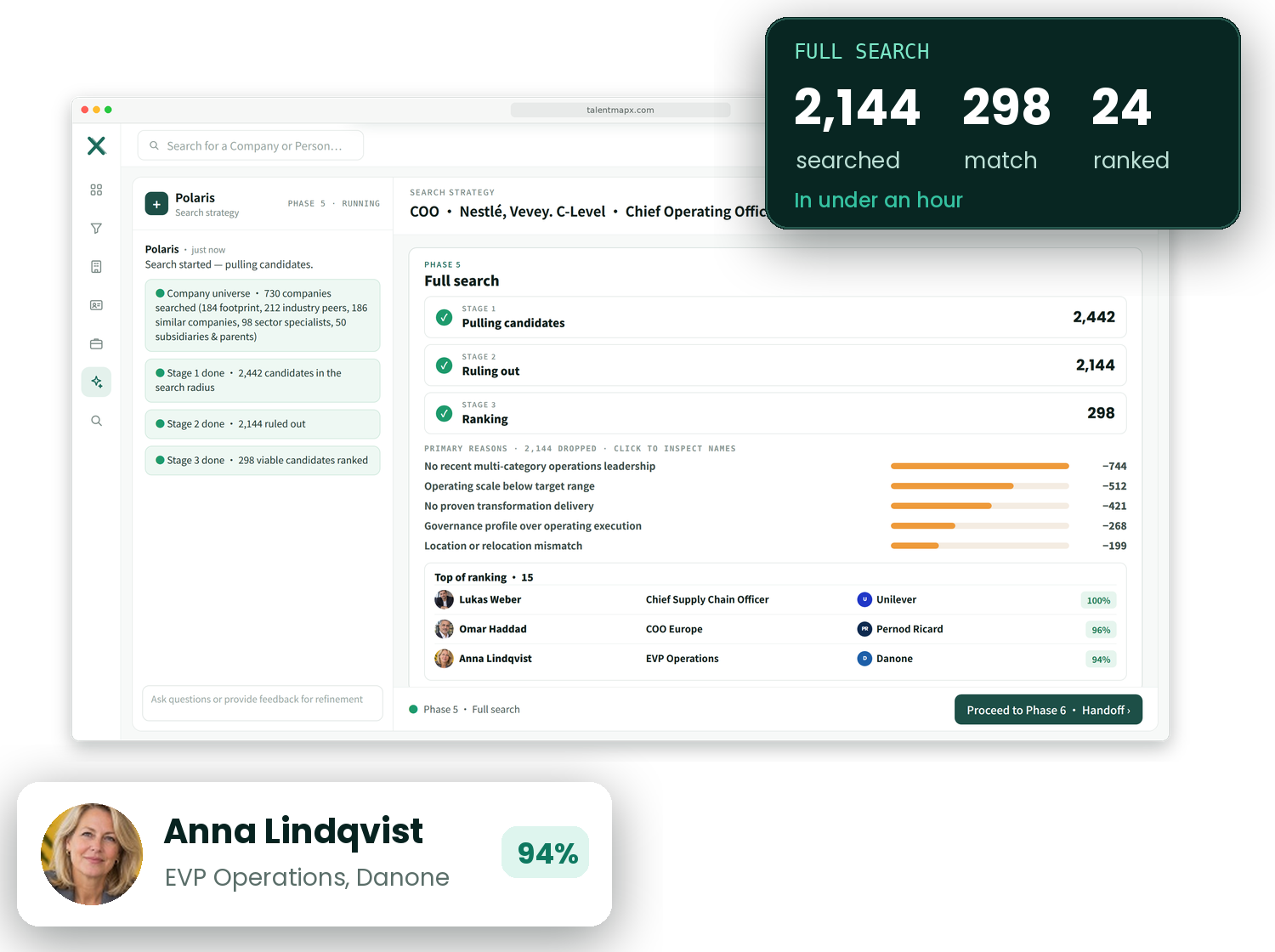
Polaris searches every senior leader at every target company, using 16 functions, 420 sub-functions and 7 seniority levels instead of keywords. People who are left out come with the reason, so nothing disappears without explanation.
-
The ranked shortlist is saved as a project with contact details for the people you choose, and turned into a shortlist report in your brand that you can send straight to the hiring manager.
Polaris, the AI executive researcher
Six steps, the way a search researcher works
You stay in control at each step. Research that takes a search firm days is done in under an hour, and a person reviews every stage before Polaris moves on.
Brief
Describe the role in plain English: the sectors in and out, the must-have experience and anything the hiring manager has ruled out.
Target list
Polaris proposes the core companies and the adjacent sectors worth searching. You agree the list before anything else happens.
Calibration
Sense-check a handful of sample profiles and sharpen what good looks like, so the full search starts from a tested brief.
Fit to brief
The brief becomes weighted criteria, each one checked against evidence in the leader’s career rather than keywords in a profile.
Full search
Polaris searches the whole market and ranks every leader, with each inclusion and exclusion explained in plain language.
Share with stakeholders
Send the shortlist and market map as an editable report in your brand, or take the answer into Copilot, ChatGPT or Claude.

Structure, not keywords
Find the leaders keyword search misses
Keyword tools match the words in a title. MapX matches what people do and how their business works, in 11 languages, so the right people turn up whatever their title.
82.5%
Classification accuracy
Job titles classified against a blind human-expert benchmark, vs 62.5% for a frontier LLM alone.
−2 wks
Time to shortlist
Customer-reported by in-house executive search teams using MapX.
−85%
Time building reports
Shortlist packs and market maps generated in your brand, not built by hand.
22m+
Senior leaders
Searched in full on every search, in 11 languages.
Teams running searches with MapX
“Faster stakeholder calibration, broader and more diverse shortlists, and reporting we can take straight to the C-suite.”
VMO2 · Managed executive search
“Org charts and market maps that used to take days of analyst time are now produced in an afternoon.”
Aston Martin · Talent intelligence
“We can confidently run executive searches in markets and functions where we have no resident expertise.”
Bacardi · In-house executive search
Questions teams ask
How accurate is Polaris?
On a blind 4,000-profile benchmark set by a human expert, MapX classifies job titles with 82.5% accuracy, against 62.5% for a frontier LLM on its own.
Does Polaris make decisions about people?
No. Polaris does the technical analysis: classifying careers and matching evidence to your brief. Your team reviews each step and makes every decision.
Can we use our own lists?
Yes. Start from your own target lists, MapX’s 2m+ companies, or both.
How long does a search take?
Most teams see a calibration sample within the hour and a full, explained shortlist the same day. The six steps that take a researcher days are done in under an hour of your time.
Can we export the results?
Yes, as reports in your brand, as editable PowerPoint or as data.
Can 6 Group researchers take it from there?
Yes. When the shortlist is ready, 6 Group’s researchers can validate it, approach candidates and screen interest, using credits on your licence.
Watch Polaris run your next search
Bring a brief. In 45 minutes we’ll run it through all six steps, from target companies to an explained shortlist you could send today.