
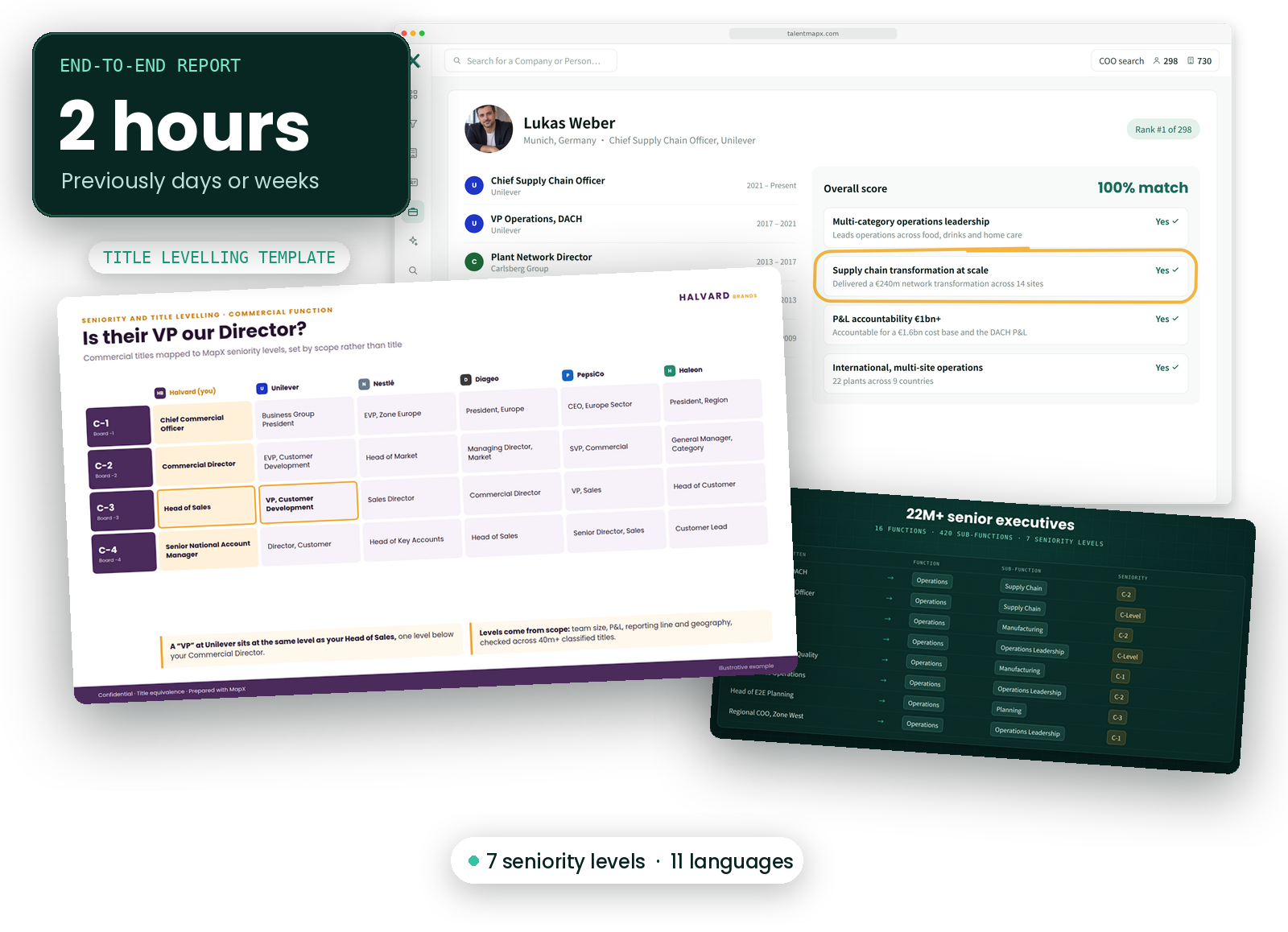
Is their VP our Director?
Map job titles across companies to one set of seniority levels, set by scope rather than the words in a title. Compare roles fairly when you hire, benchmark or build a job architecture.
THE PROBLEM
Titles mean different things at different companies
A VP in one company runs a country; in another, a team of five. Internal job architecture only levels your own roles, and keyword searches take titles at face value.
Job title levelling fixes the comparison. MapX reads what a role actually covers, in 11 languages, and places every title on one seven-level scale, so a Director at one company and a Senior Manager at another can be compared properly, and your own grades can be mapped to the market.
Your job architecture levels your roles, not anyone else’s.
Keyword searches treat every VP as the same job.
Salary surveys match on title, so inflated titles distort the benchmark.
MapX levels on scope and evidence, across companies, sectors and languages.
Questions it answers
Which level is this title at each competitor? Every title is placed on the same scale using scope, team size and reporting line, so you can see where it really sits rather than how it reads.
Are we hiring at the right level for this role? Compare the level of the role you are advertising with the people who do the equivalent job at the companies you compete with for talent.
How do our titles compare with the market’s? Map your internal grades onto market levels to find where your titles are ahead of, or behind, the companies you benchmark against.
Where are titles inflated in our sector? Patterns of title inflation show up clearly by sector and by company, which matters for both hiring and retention.
-

Level by company
Which level is this title at each competitor?
-

Right level?
Are we hiring at the right level for this role?
-

Our titles vs market
How do our titles compare with the market’s?
-

Title inflation
Where are titles inflated in our sector?
The ingredients behind the answer
Every company and career in MapX is classified the same way. Combine the ingredients and the answer gets sharper. Polaris does this for every search.
For title levelling, MapX reads the scope behind each title, including team size, reporting line and the scale of the business, and places it on one seven-level scale across every company you compare.
-

Functions
40m+ job titles classified into 16 functions and 420 specialisms.
-

Seniority
Seven levels, set from team size, P&L, reporting line and geography.
-

Companies
How each company uses titles, from flat to inflated.
-

Progression
The usual next step from each level.

What the output looks like
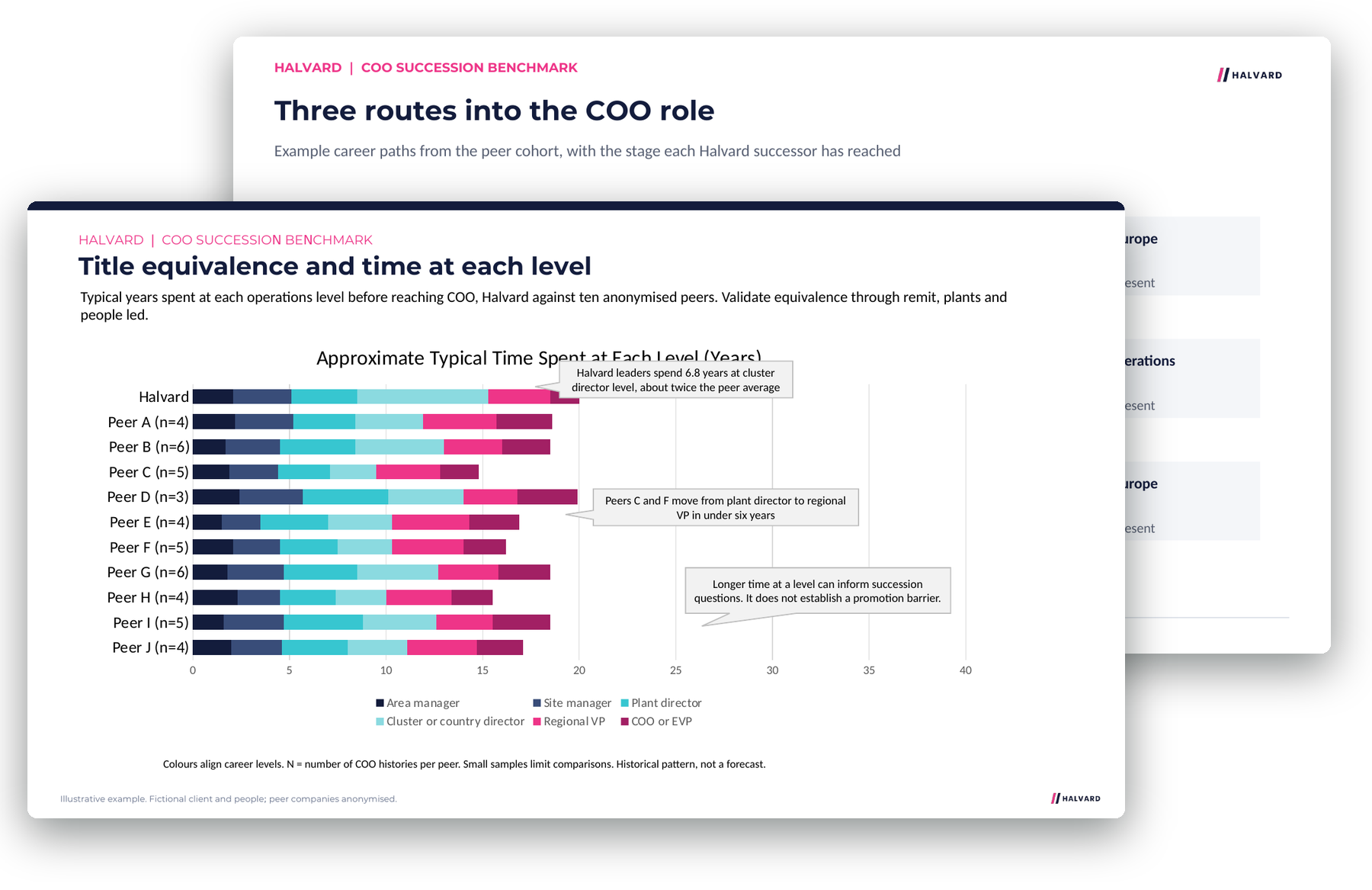
Job titles across employers mapped to one seniority scale, with the time leaders typically spend at each level and the routes between them. Shown in a client’s brand, with illustrative data and fictional people.
Job titles across employers mapped to one seniority scale
The time leaders typically spend at each level
The routes between levels, and where titles are inflated
Reward, job architecture and recruitment teams use it to set the right level for a new role, to sense-check grades against the market, and to make sure a search targets people at the right level rather than the right title.
22m+
Senior leaders profiled, worldwide
2m+
Companies classified, public or private
420
Specialisms across 16 functions
11
Languages read in job titles
Questions teams ask
What teams ask before they start.
How is a level set?
From scope: team size, P&L, reporting line and geography, checked across 40m+ classified titles. The words in a title are only one signal.
How many levels does MapX use?
Seven seniority levels, applied the same way at every company, so a title at one business can be placed against an equivalent at another.
Does it work in other languages?
Yes. MapX reads job titles in 11 languages, so a Directeur, a Leiter and a Head of are levelled on the same scale.
Can we map our own grades?
Yes. Map your internal grades onto MapX levels to see where your titles sit against the market.
Can it support job architecture work?
Yes. Many teams use it as the external reference for a job architecture project, with 6 Group’s experts on hand for the internal mapping.
Does it help with pay benchmarking?
It makes pay data more reliable, because roles are matched on level rather than title. Pay benchmarks themselves come from 6 Group’s research team as an add-on.
How do we get started?
Two calls: one to set up your report library in your brand, and one to level a first set of roles together.
Which sectors are covered?
All of them. MapX classifies 2m+ companies, public or private, so titles can be levelled within a sector or across sectors.
Level one role across your peer set
Book a 45-minute demo. Bring a live search or a talent question and we'll show you what MapX finds, and what you'd get. Or start with the free sample pack: three finished reports in a client's brand.